How to tell a divided highway from an undivided one in satellite imagery
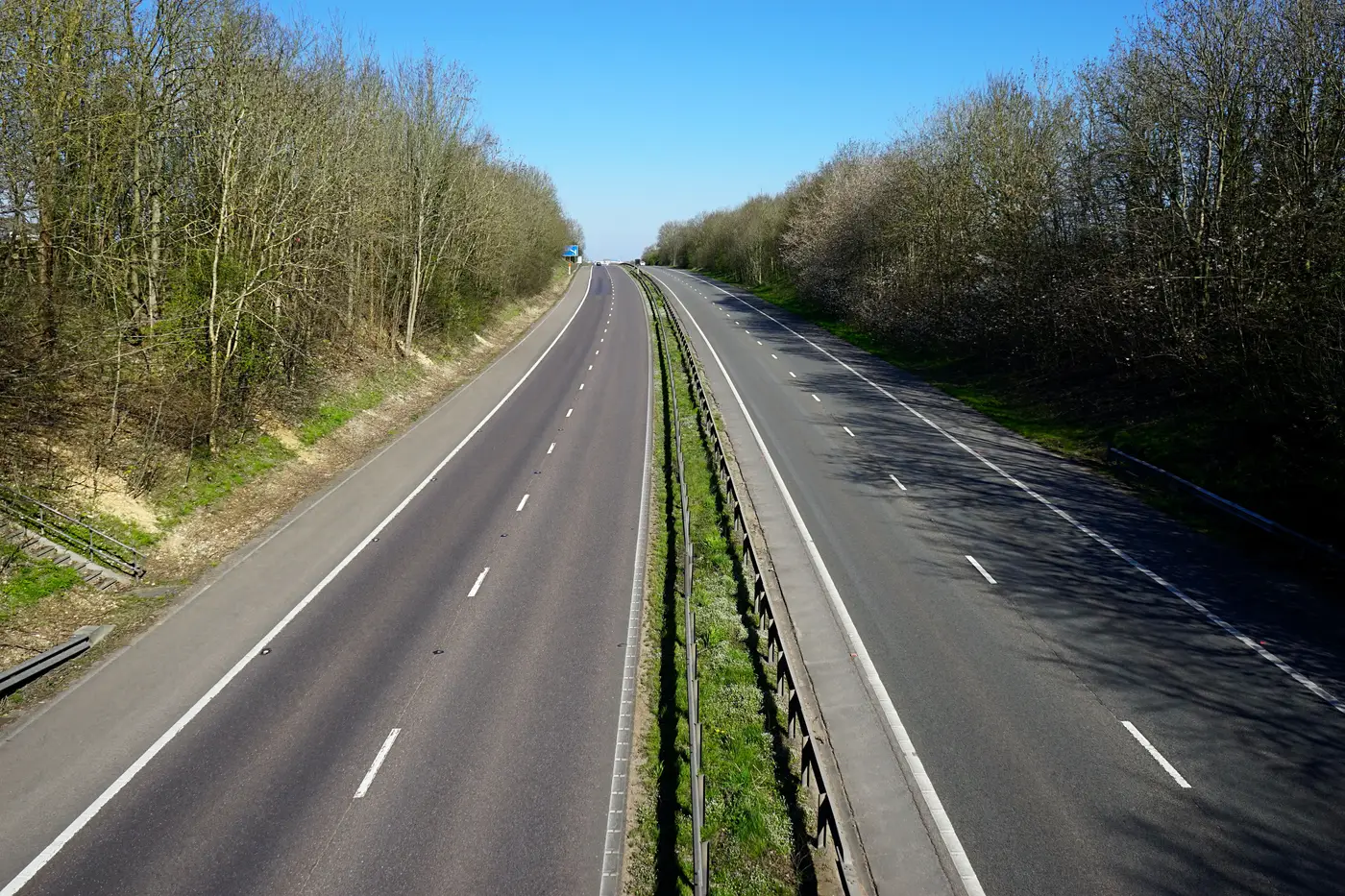
If you've ever had a QA ticket come back because a four-lane arterial got tagged divided=no, you already know why this distinction matters more than it looks like it should. Divided versus undivided isn't cosmetic. It feeds turn restrictions, speed inference, and crash-risk weighting in a routing graph, and getting it wrong in one direction sends traffic down a center-turn-lane road like it's a freeway, and in the other direction treats a freeway like a rural two-laner.
Here's what actually separates the two on imagery, and where it falls apart.
What you're actually looking for
A divided highway has a physical median: grass, a concrete barrier, jersey wall, raised curb, or a planted strip, separating opposing traffic directions. An undivided highway has opposing lanes separated only by paint, sometimes with a center turn lane that looks like a gap but isn't one.
At 0.5-1 m GSD, a grass or concrete median usually shows up as a clean, continuous band running parallel to the road, often with a slightly different spectral signature than the pavement on either side (greener if planted, brighter if concrete). At 1-2 m, that band gets fuzzier; a narrow median under about 3 meters can smear into the roadway in the pixel averaging, especially under tree canopy shadow.
The tell that catches people out: a center turn lane. It's wider than a paint stripe, it has hatching or a solid double line, and at a glance it reads as a gap between two roadways the same way a median does. It isn't one. No physical separation, no median, still an undivided road for tagging purposes even though three or five lanes are visible.
Where median detection gets hard
A few situations make the call genuinely ambiguous from imagery alone, not just hard:
- Narrow medians under canopy. Tree cover over a 2-3 m median reads as continuous shadow in both directions. You're often inferring from the road's overall width and curb pattern rather than seeing the median directly.
- Interchange ramps and frontage roads. A divided highway's mainline splits into ramps that briefly look undivided on their own. Classify the mainline and the ramp as separate segments, not one continuous attribute.
- Variable medians. Some corridors alternate: concrete barrier through an urban stretch, painted buffer through a rural one. The attribute changes at the transition point, which means the segment has to split there too, even if nothing else about the road changes.
- Construction and resurfacing. A median under construction can look like bare dirt or temporary barrier that reads as neither clearly divided nor undivided. If the imagery date is mid-project, flag it rather than guess.
Getting it into routing attributes consistently
Spotting a median on one stretch of road is the easy part. The real difficulty is consistency: doing the call the same way across a few thousand kilometers of road without drift between analysts or between imagery vintages. A tech who calls a 2.5 m grass strip "divided" on Monday and "undivided" on Friday because the shadow angle changed isn't being sloppy, they're running into the actual limit of eyeballing it segment by segment at volume.
That's the part worth automating rather than the part worth training harder on. If your team is re-walking the same corridors every cycle just to catch the segments where a median got added, a lane got restriped, or a ramp got rebuilt, that's exactly the kind of recurring, bounded comparison a vector diff is built for: new and changed segments extracted from the current high-res pass, delivered as a layer you merge against what you've already got, instead of re-reviewing the whole network to find the handful of changes. If that's where your QA queue keeps backing up, see how Road Extraction's quarterly diff handles it.
Whatever method you use, write down the rule before you start the pass: minimum median width counted as "divided," how ramps get segmented from mainline, how construction-state segments get flagged for a re-check next cycle. The rule matters more than any individual judgment call, because the next person coding the next batch needs to make the same call you did.